Showing posts with label dental implants. Show all posts

Thursday, November 13, 2014

Diane's Dental Makeover

Diane underwent several months of dental treatment to achieve her new smile. This included periodontal therapy, dental implants to support an anterior implant bridge and additional crowns on her upper teeth.
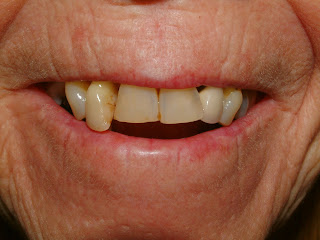
before


after
1. Why was Diane a good candidate for these procedures?
This patient presented with an advanced chronic Periodontal infection which required many steps in order to achieve healthy tissues and improve her overall health.
The fundamental basis of implant treatment is to make sure that the overall condition of the patients mouth is absolutely healthy. Otherwise, we can compromise the health and longevity of implant and prosthetic treatment. After treating the Periodontal disease and achieving a stable and healthy condition of the patients gums,then we proceeded with planning for the replacement and rehabilitation of the missing teeth.
2. How did you develop a plan for treating Diane's concerns?
The front teeth required removal as they were too compromised to keep them and treat them periodontally. The patient knew this from the outset and she also knew that the ultimate replacement will be done with an implant supported fixed prosthesis.
Once her teeth were extracted in the upper front, a bone graft was placed in order to maintain and regenerate her jaw bone which would provide an adequate anatomical area to place two implants. We allowed a period of 6 months of healing from the time of tooth extraction, bone grafting and implant placement.
A cone beam CT scan was done at the 6 month period and a virtual implant surgery was done in order to make a custom surgical guide. This guide was used during surgery I. Order to place the implants in he exact position required for this particular case.


3. Was her treatment out of the ordinary?
Her treatment consisted of first bringing back health to her gums and teeth, making sure that a stable periodontal condition was present in order to continue with her implant treatment plan. It's a very detailed plank which requires many steps in order to prepare the mouth for dental implant surgery.

4. How long did Diane's transformation take?
The treatment time was 16 months (?) I don't have marks notes so not sure when re placed the final bridge.
5. Is there an ideal candidate for these procedures?
The ideal candidate is always one which is healthy, complies with all appointments and instructions, and of course protects the final prosthesis with wearing a night guard and keeping all maintenance dental visits.


Jonathan Mursic                                                        Connie
 5 Axis Lab                                                                Treatment Coordinator


Thursday, May 30, 2013

Martine's smile makeover!

Martine underwent several months of dental treatment to achieve her new smile. This included several root canals, surgical crown lengthening of upper anteriors, full crowns on all upper teeth and 5 dental implants to replace missing teeth in her lower jaw.


Why was Martine a good candidate for these procedures?

Martine was a good candidate because she was motivated. She understood that she would get immediate temporary results but the final permanent restorations were highly technique sensitive and would require several months to achieve.


                      Before                                                                         After

How did you develop a plan for treating Martine's concerns?

Although Martine’s initial concern was the overall appearance of her smile, we had to make sure that a beautiful smile starts with function. After all, she needs to be comfortable eating. Treatment plans always start with the evaluation of the supporting structures, the bone and the gums. These form the foundation of a long lasting result. Once the gums, bone and the bite have past the test, a smile can be constructed that is natural and beautiful. In the mean time we were able to get Martine back her smile immediately with a temporary restoration that we could use to develop her long lasting smile.

Was her treatment out of the ordinary?

Absolutely! Although we are not strangers to complex cases such as Martine’s, each case of this magnitude has it’s own challenges. Any treatment that takes several months requires several disciplines in dentistry. In this case, the expertise of several specialists was called into play so the coordination of Martine’s primary care dentist was very important. This is made easier when all of the specialists are housed under one roof as they are at Dentistry on Dundas.

How long did Martine's transformation take?

The initial transformation was almost immediate but several treatments were required over a year period till we could reach our final goals.

What steps do these procedures involve?

Treatment planning, Treatment planning, Treatment planning! …..followed by a series of logical treatment steps keeping in mind that twists and turns may arise that require adaption and flexibility.
 

                 Before                                                                               After

Is there an ideal candidate for these procedures?

Martine and patients like her that are motivated are ideal for this type of treatment. They understand the insurance plans do not dictate what treatment is required, the patient and their dental health does.

Are there any at-home steps patients should follow after procedures like these?
As with anything manmade, how you take care of it plays a huge factor on any restorations longevity. After all, Gods work didn’t last forever either. So home care, regular visits to the dental office, paying attention to small problems quickly as they arise and protecting the restorations at night through use of a nightguard will go along way to extending the life and beauty of the smile we have created.
Treatment provided by Dr. Mark Librach and Specialists at Dentistry on Dundas
Dr. Jon Rapp                                        Dr. Chris Chen                                  Dr. Dana Levy  Endodontist                                          Oral Surgeon                                     Periodontist
Jonathan Mursic RDT,                                                      Connie
President of 5 Axis Dental                                         Treatment Coordinator

Wednesday, March 20, 2013

Dental Implant Marketing: Truth vs Fallacy


We are all inundated every day with advertising and product placements for virtually everything that surrounds us. This includes as well marketing in the dental field which is directed to the public.
One of the treatment option we suggest, as Periodontists, are dental implants for replacing missing teeth. Today they are the best treatment option for single or multiple missing teeth.

From the moment that my patient is contemplating the possibility of replacing his/her missing tooth or teeth with implants, it is a very complex and well thought out process which includes: a thorough oral examination, digital X-rays, providing a comprehensive oral and periodontal exam, discussion of function (chewing and speech), discussion of aesthetics, and of course discussion of alternate treatment options. Within this framework I have to listen to the patient's desires and what are the long term goals and objectives when it comes to oral rehabilitation. Implant treatment carries as well a significant commitment on behalf of the patient, as long term maintenance is imperative for success.

Having said all of this, patients can be very confused by the myriad of treatment plans they receive when they are " shopping" for a general dentist, periodontist or surgeon that will deliver the implants and the prosthetic treatment that they are ultimately looking for. As part of our patient's education, I always stress the importance of comparing apples to apples, making sure that they are given the absolute best treatment care as well as making sure that all the preliminary steps have been taken in order to achieve maximum success and beautiful results.

I would like to direct you to this excellent blog post (see below) which shows how implant treatment plans can vary and how deceiving it can be if we don't really know what is being offered. Cost variation is extreme and can be misleading and it reinforces the fact that not every treatment plan is equal and / or as comprehensive as the next one.

As long as our patients understand how dedicated we are and the time commitment which we invest is crucial in obtaining optimal results, then I feel that we have given the best service to our patients.

Please take a moment to read an excellent blog from an Oral Surgeon in the US click here for link.

Periodontics & Implant Dentistry

Thursday, February 7, 2013

Twenty years in practice!

As I enter my 20th year of practice as a Periodontist, its incredible to see how technological advances have improved the way we practice and also the great outcomes we achieve. Having said this, the way we communicate with our patients individually and the dental community as a whole has opened up a world of possibilities to educate ourselves and also our patients with important issues that really matter and affect us as individuals. Through Social Media, be it Facebook, Twitter, Blogs, the world is literally at our fingers, thus, we are further exposed to the possibility of "reaching out" and become a strong voice for our profession. This will mark my first entry as a "blogger" , as a Periodontist who wants the rest of you, out there, to learn a bit more about interesting health issues which affect us all and are an important part of maintaining our overall health.

To read more about Dr. Dana Levy Click Here

Thursday, May 5, 2011

Implant Dentistry Day One

Dr. Levy, Periodontist at the Piezoelectric Bone Surgery


International Symposium May 5 to 7, 2011

Having the opportunity to come to Lugano, one of the most beautiful towns in the Italian Swiss alps, only enhances my excitement over the fact that we, at Dentistry on Dundas, are at the cutting edge of surgical technology (among others!). In essence, what dental implants were 30 years ago (first North American conference was in our own Toronto), ultrasonic piezosurgery is today leading the way in greater dental implant surgery.

Ultrasonic Piezosurgery is just another very high tech name for a very cool machine that instead of using drills to open holes in the bone before putting the impant in, it actually uses special diamond coated 'inserts' that go at an extremely fast speed (compare a smart car to a formula one car). So, this speed is so fast, that it causes 'waves' at more than 30.000 per second, wow! So, with lots of water, there is barely any heat on the bone, and its so precise! For those that have narrow bone or very soft bone, its just the ideal new way for having implants done!

As learned today, my first day in this three day conference, we can place implants with far less swelling, much more precision and far greater initial and long-term stability than what can be achieved with our regular implant drills.

I'm excited for our future and also keen to use this in our office for all our implant patients. Stay tuned for day #2!!!


Monday, January 10, 2011

Dr. Lanys interview on Bizymoms website

An interview with Dr. Lanys on Dental Implants.


What are Dental Implants?

Dental implants are metal root replacements for missing teeth that are placed into the bone. They take approximately 4 to 6 months to integrate with the bone at which time they are able to support a crown (cap), bridge or denture. Even if there is any bone loss from previous infection, periodontitis, etc., a bone graft can be placed before the implant to replenish some of the lost bone.

What are dental implants made of?
They are made of titanium and coated with a titanium alloy which is compatible with bone.

How long do they last?
Dental implants have a very high success rate of over 95%. A large advantage to this procedure is that if they are placed and subsequently integrated, they usually last indefinitely. There are, however, certain risk factors that may compromise the integration process or the longevity of the implant.

How are dental implants placed?

Implants are typically placed by an oral surgeon, periodontist, prostodontist, or a trained general dentist. This can be done under local anesthetic or sedation depending on the case and usually involves no discomfort during, and minimal discomfort after the procedure.

There are special x-rays or tomographs that are taken prior to placement to ensure all vital structures, such as nerves, are avoided and the implants are placed only within bone.

Before placement or on the day of surgery a temporary denture is inserted to ensure the patient never goes with missing teeth. When the implants are integrated some months later, the prostodontist or general dentist places the dentures, crowns or bridges securely onto the implants.

Risk factors or contraindications of dental implants.
The main risk factors associated with implants are smoking, poor oral hygiene, diabetes (especially if uncontrolled), other compromising diseases, and possibly some medications.

It is important to review your health history thoroughly with your dentist before commencing any dental treatment, including implants.

Will my implants feel like my natural teeth?

One of the main advantages of implants is that they do feel like natural teeth. They function and look like natural teeth, do not decay or require root canals. They maintain the surrounding bone, whereas if there was no tooth or implant, the bone would resorb or recede.

This is one of the only procedures that replace teeth without affecting any existing teeth in the mouth. They are by far the best treatment option to replace missing teeth and are widely used in my practice, resulting in many very happy patients.