Thursday, February 15, 2018

Meagan's orthodontic before and after photos!

Meagan went through orthodontic therapy with Dr. Librach to create her new beautiful and functional smile!


1. Why was Meagan a good candidate for orhtodontics?

Meagan was keen to have her straight teeth. She is a great listener and followed instructions well.  Her Oral hygiene was also good.

2. How did you develop a plan for treating Meagan?

Starting with all the appropriate records, including photos, x-rays, and models, a thorough exam is done. We can then devise a treatment plan that would correct both tooth position issues and underling skeletal problems. We then consult with the patient and her parents, taking into account all of their concerns. 

Before

3. Was her treatment out of the ordinary?

There really isn't any "ordinary" cases.  They all are special and treatment plans are tailored to each patient.  Some are complex and others, like this one are less so.

4. How long did Meagan's transformation take?

Her treatment plan was completed in 18 months.

5. What steps do these procedures involve?

She had six months of appliance therapy and twelve months of braces.

6. Is there an ideal candidate for these procedures?

A patient who is a good listener and follows instructions can vastly reduce the length of treatment.  Children who accept the responsibility for part of their treatment can accelerate the process and finish early. Good listeners who take responsibility for their own treatment and don't rely on their parents for day-to-day maintenance make the idea patients.

After

7. Are there any at-home steps patients should follow after procedures like these? 

Retention and oral hygiene are key to the long term success of any orthodontic treatment.  Retention is a lifelong endeavour as teeth are subject to changing forces as we age, any of which can affect the position of a tooth or many teeth.  Depending on the treatment done, full time retention (usually for one year) is required followed by night time wear there after.  Oral Hygiene is also key for the oral health of the patient.

Follow us on Facebook


Tuesday, March 14, 2017

Children's dental cavities are preventable

Dr. Mark Librach on Daytime Durham March 9, 2017

                                                    click here to see the full program

What does decay look like?
Although decay may appear as a discolouration or a pitted appearance on a tooth, it is actually diagnosed by feel using a sharp instrument called an explorer.  Decay will present itself as a “sticky” pit on a tooth when examined with a dental explorer.  In addition, dental x-rays can help diagnose decay in areas our instruments can’t reach, specifically the surfaces between teeth.

What is preventive dental care for children?
Preventative dental care in children includes brushing at least twice a day. The most important time for brushing is right before bed.  The second most important time is right after breakfast in the morning.  This applies to adults as well. Flossing 2-3 times a week is also important.  Parents should be active participants in their child’s oral health.  They should promote the child’s attempt to brush their own teeth and fill in the gaps for a thorough cleaning.  When it comes to flossing, the duty will fall to the parents.  Parents should also lead by example by taking care of their own oral health in front of their children.

At what age should I first take my child to the dentist? 
An infant should be seen by a dentist when their first tooth erupts and no later than one year of age.  The rational behind this early approach is to get the child’s oral health off to good start and to educate parents as to the best methods of keeping their children healthy with respect to their teeth.  

Is it necessary for me to clean or brush my baby's teeth?
Absolutely!  Tooth decay can start immediately after a tooth erupts in the mouth so oral hygiene must start immediately.  At first, baby teeth can be cleaned with a clean damp terry cloth. As the child matures, a specifically designed baby toothbrush can be used.

What is "Baby Bottle Tooth Decay"?
Baby bottle tooth decay is a completely preventable tragedy that is brought on by lack of oral health education.  It is most commonly caused by infants being put to sleep with baby bottles that contain milk or juice.  As the child pacifies itself with the nipple on the bottle, the acidity form the juice or milk bathes the teeth breaking down the enamel and causing rampant decay.

What is fluoride and does my child need fluoride treatments?
Fluoride is a natural mineral that is derived from the earths crust. It is sometimes naturally found in water supplies but many jurisdictions have added fluoride to drinking water as a matter of public health to help prevent tooth decay. It is also found in foods and is the main cavity-preventing ingredient in toothpastes.  In addition, your dentist may include topical fluoride treatments as part routine oral care appointments for children.  Fluorides in all these forms help decrease the incidence of cavities.

What are sealants and should my child have them?

Sealants are plastic coatings applied to teeth to help prevent cavities.  If required, they are usually applied to the first adult molars that erupt at age six, but can also be applied to molars that erupt at age 12 also. The determination of whether to place sealants takes into consideration the cavity history of the child and the “grooviness” of the teeth.  A child that has a history of several cavities in their baby teeth and has “groovy” teeth is a prime candidate for sealants.


Dr. Mark Librach Dentistry on Dundas

Thursday, May 26, 2016

JP's Dental Makeover

JP underwent dental treatment at Dentistry on Dundas to achieve his new smile, which included dental bleaching, anterior bonding and porcelain crowns.
1. Why was JP a good candidate for these procedures? JP was a great candidate because he had healthy gum tissues free of periodontal disease, specific treatment goals and excellent home care and compliance. 
2. How did you develop a plan for treating JP's concerns?
Understanding the specific concerns of JP was essential to a positive outcome. JP was unhappy with the appearance his existing teeth restorations (an older crown on one lateral incisor and a large composite resin restoration on the other). JP wanted to enhance his smile without appearing unnatural.

3. Was his treatment out of the ordinary?
JP’s treatment was not out of the ordinary. Our goal was to be as conservative and cost effective as possible. Multiple treatment options were recommended but together we came up with a plan that met his specific functional and esthetic concerns after evaluating the advantages and disadvantages of all treatment options.
4. How long did JP's transformation take?
The total transformation took under 2 months. 
5. What steps do these procedures involve? Our first step was the assessment of JP’s overall and oral health; because he attends his regular check up and hygiene appointments there were no unexpected complications. The next step was to fabricate customized home bleaching trays to improve the shade of JP’s teeth and smile. After the optimal shade was achieved we gently removed his previously existing restorations, digitally scanned the tooth preparations and produced lab fabricated restorations. This helped restore JP’s teeth to their natural shape and size, strengthen his teeth and enhance his overall appearance. 


                                                         Before


                                                        After 
6. Is there an ideal candidate for these procedures?
The ideal candidate is someone who is engaged in preventative dentistry and regular maintenance visits. Minimizing risks and complications are enhanced when a patient presents with no active disease such as caries and inflammation. 
7. Are there any at-home steps patients should follow after procedures like these? Based on JP’s functional habits a night guard was recommended to reinforce home care and prevent future breakdown of his natural teeth and tooth restorations. In addition proper brushing and flossing techniques are always recommended.

Treatment Completed by Dr. Cara Lindsay


Thursday, October 22, 2015

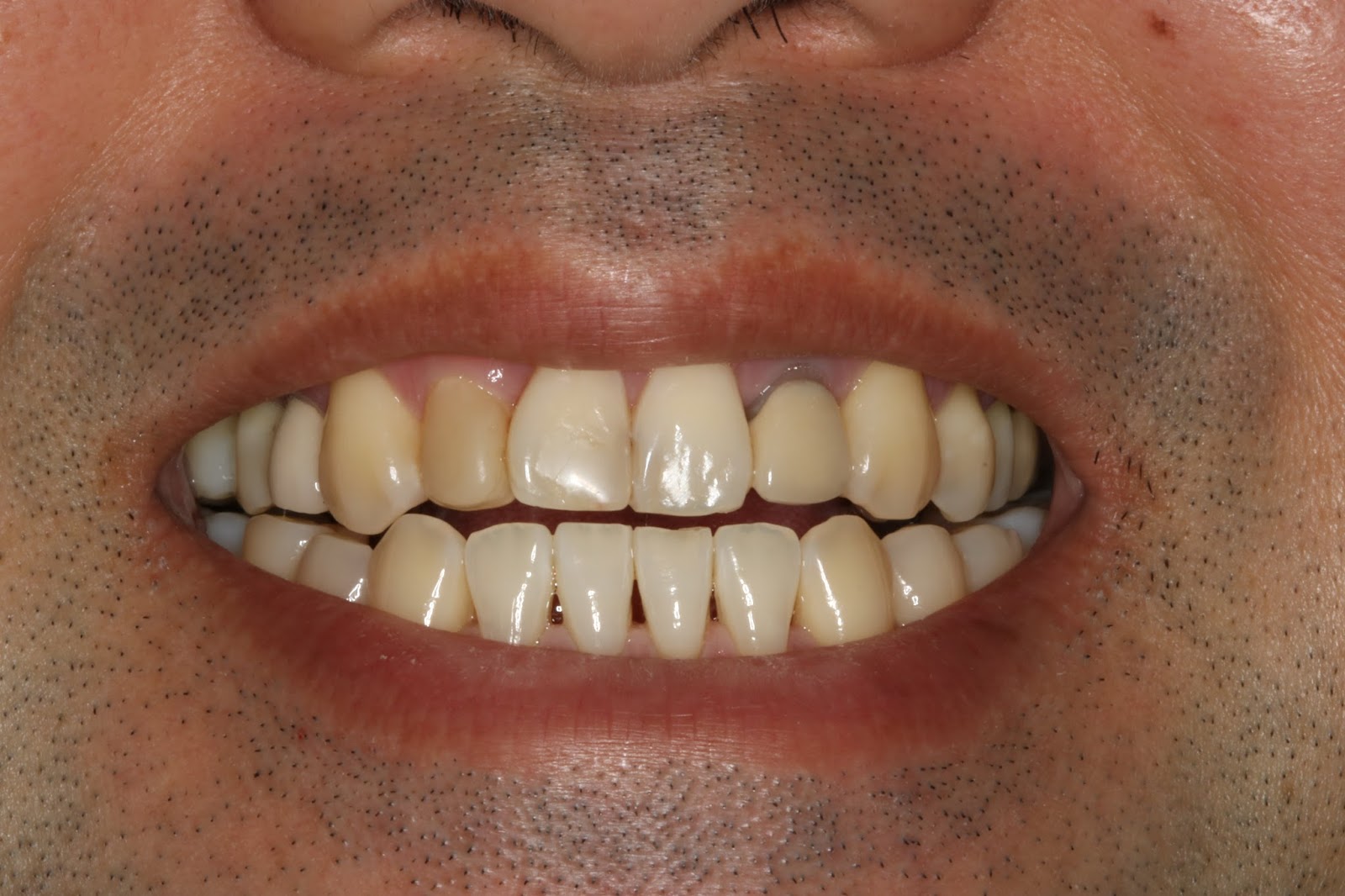
Jim's Dental Makeover

Jim underwent dental treatment at Dentistry on Dundas to achieve his new smile, which included a new anterior bridge.


Before

After
 
1) Why was Jim a good candidate for these procedures?

Jim was an excellent candidate for a porcelain bridge replacing the upper two anterior incisors.
He had a removable denture for many years which served him well. At this point of his life, he was ready to have something that felt and looked more natural. His biting forces were not excessive in this area as well, rendering it an excellent position for a bridge.
 
2) How did you develop a plan for treating Jim's concerns?

Jim wanted an alternative restoration to replace his anterior teeth for quite some time. He wanted something more comfortable and more "natural" looking. Many options were discussed, including implants. After considering timing and finances, he chose a fixed bridge.

Before

After
 
4) How long did the transformation take?

It was simply two appointments. The first was 90 minutes, the second was 45 minutes.

5) What steps do these procedures involve?

During the first appointment, the patient is given a small amount of local anesthetic. The teeth are prepared and scanned with a special computer to create a model whereby the bridge is made. He leaves the first appointment with temporary restorations on the prepared teeth. At the next and final appointment, the bridge is permanently cemented with no anesthetic.
 
7) Are there any at-home steps Jim should follow after procedures like these?

Jim should practice excellent oral hygiene and visit the dental office for regular follow up recall cleaning appointments. For this particular bridge, as any, the patient is shown how to clean and floss with a special floss threader required for bridge work.

Treatment Completed by Dr. Michelle Lanys


Thursday, September 17, 2015

Readers Choice Award Whitby/Oshawa 2015

We need your Vote!

The Whitby/Oshawa 'This Week' Readers Choice Awards is now online!
 
http://survey.metroland.com/TakeSurvey.aspx?SurveyID=94KH9m73
It will also be posted in your local paper.
Online voting will be accepted from
Until Sept 27, 2015

Click here to Vote for us Now 


It is a privilege to care for you and your family's dental health needs and we appreciate your 'Vote' of confidence. It is truly an honour to be awarded the Readers Choice Award. Thank you for taking the time to let us and your community know your favourites!
 

Wednesday, July 29, 2015

Dental Makeover for Michael Penney!

Michael underwent dental treatment at Dentistry on Dundas to achieve his new smile, which included teeth bleaching and four anterior veneers.


1.     Why was Michael a good candidate for these procedures?

Michael had discolouration of his anterior teeth along with misalignment. This cosmetically bothered him for some time so he decided to pursue treatment. After consultation with Dr. Millman and treatment coordinator, Connie, they decided on a plan.

2.     How did you develop a plan for treating  Michael's concerns?

After evaluating the various options he decided on initial teeth bleaching followed by veneers, as this was the most conservative treatment to achieve the maximum results in the shorted time. Michael had a goal of a short time frame for an important event. Based upon Michael's expectations, we determined that all four anterior teeth must be treated in order to achieve the best cosmetic and alignment results.


3.     Was his treatment out of the ordinary?

This is a very common treatment recommendation to achieve an outstanding result in a very short period of time. He could have opted for orthodontic treatment to correct the misalignment, however this would not correct the discolouration and would have required a longer commentment from Michael. Four simple veneers solved both issues in a short period of time.

4.     How long did Michael's transformation take?

Two weeks bleaching his teeth and two consecutive appointments, two weeks apart, for the veneers to be placed.

5.     Is there an ideal candidate for these procedures?

The ideal candidate is always one which is healthy, complies with all appointments and instructions, and of course protects the final prosthesis in keeping all dental maintenance appointments.

6.     Are there any at-home steps patients should follow after procedures like these?
 
It's essential to maintain the margins of the new restorations, therefore, good oral hygiene is vital, at home and in keeping all regular dental cleanings and check-ups.

Treatment completed by Dr. Steven Millman


Jonathan Mursic                                                        Connie
 5 Axis Lab                                                                Treatment Coordinator


Wednesday, November 26, 2014

Martin's Dental Makeover


Martin underwent dental treatment to achieve his new smile, which included orthodontics, 6 anterior crowns and bonding of his lower anterior teeth.


What were Martin's initial concerns, and what was your plan for addressing them?

Martin's teeth were badly broken down.  Through many years of wear and tear from grinding, Martin's teeth were now wider than they were long.
Martin hated his smile or the lack of it.  He had to really try hard to show any teeth at all and what he could show were not aesthetically pleasing.
Since Martin's teeth were edge to edge with no overlap, just placing new crowns or veneers were impossible.  Something had to be done to get some space between his incisors.

What procedures did you perform and why?
In order to get some space we had to use orthodontics to move teeth.
Instead of standard braces we used invisalign to open the bite to accommodate the crowns he would need from canine to canine.  This took about two years to accomplish.
We used bonding along the way to mock up his teeth to a comfortable bite and aesthetically pleasing position.  Once Martin was comfortable, his final crowns were placed.
The results are spectacular!!

  Dr. Mark Librach - Dentist